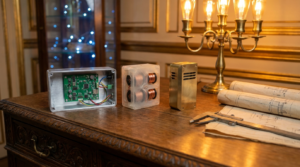
The most useful questions to ask a prototype development company are the ones that force a clear answer on five things before you sign: whether the team has built something like your product, what kind of prototype you actually need, what it will cost with the exclusions spelled out, who owns the result, and what happens once the prototype works. A good partner answers each of these in plain language on the first call. A weak one answers with a slide deck. Below are the 12 questions we would ask if we were in your seat, why each one matters, and what a strong answer sounds like.
We write this from the other side of the table. Prototype Toronto is the technology development arm of Veebar Tech Inc., and we work with non-technical companies as their technical partner for prototyping and product engineering, AI development and integration, and digitalisation. We would rather you hire the right team, even if that team is not us, than start a build that stalls in month three.
What a prototype development company should do for you
A prototype development company turns an idea into something people can click, hold or test, so you learn whether it works before you spend the full product budget. That might be a clickable app design, a working proof that an AI model can read your supplier invoices, or a 3D printed enclosure with live electronics inside. The point is evidence. Every prototype should answer a specific business question, such as “will customers pay for this?” or “can this sensor survive a winter on a job site?”
That framing changes how you evaluate vendors. You are not buying hours of engineering. You are buying the fastest reliable route to an answer. Keep that in mind as you work through the questions to ask a prototype development company below, because the strongest answers always tie the work back to the decision you need to make.
Questions to ask a prototype development company about fit and experience
The first three questions test whether the team has solved problems like yours before and whether they will recommend what you need rather than what is easiest for them to sell.
1. Have you built something close to this before, and can I see it?
Ask for two or three relevant examples and a reference you can call. “Relevant” means similar technology or similar constraints, not necessarily the same industry. A team that has built a connected device with a companion mobile app will understand the pairing and battery headaches of your smart equipment product even if they have never worked in your sector. If every example is under a non-disclosure agreement, ask for a screen-share walkthrough with the sensitive details hidden. A company with real experience can always find a way to show it.
2. What type of prototype do I actually need?
Of all the questions to ask a prototype development company, this one saves the most money. Many founders ask for a minimum viable product (MVP), meaning the simplest version real customers can use, when a two week clickable prototype would answer their question for a tenth of the cost. A good partner will push back and recommend the smallest build that produces the evidence you need. Typical options look like this:
| Prototype type | What it proves | Typical timeline | Typical cost range (CAD) |
|---|---|---|---|
| Clickable design prototype | Users understand the product and want it | 1 to 3 weeks | $3,000 to $12,000 |
| Technical proof of concept | The hardest part works, such as an AI model, a system integration or a sensor reading | 2 to 6 weeks | $8,000 to $30,000 |
| Software MVP | Real customers will use it and pay for it | 8 to 16 weeks | $30,000 to $120,000 |
| Functional hardware prototype | The device works in real conditions | 2 to 6 months | $25,000 to $150,000+ |
These are market ranges, not quotes. Complexity, integrations with your existing systems and regulatory requirements all move the numbers. If a company quotes an MVP before asking what decision the prototype needs to support, treat that as a warning sign.
3. Who will actually do the work?
Ask for the names and roles of the people on your project, and whether any part is subcontracted or sent offshore. Sales calls are often led by senior people who disappear after the contract is signed. You want to know who writes the code and who you call when something breaks. Also ask how many projects each person carries at once. A lead engineer split across six clients will not move your project at the pace the proposal promises.
Questions about process, timeline and communication
Process answers reveal whether the team has done this enough times to have a repeatable method. These are the questions to ask a prototype development company when you want to predict how the next three months will feel.
4. What happens in the first two weeks?
A strong answer is specific: a discovery workshop, a written requirements summary, a list of technical risks ranked by how likely each one is to sink the project, and a date for the first demo. Vague answers like “we will get aligned” usually mean the team will work it out on your budget. The first two weeks should end with a short document you can read in fifteen minutes and either approve or challenge.
5. How do you handle changes in scope?
Your understanding of the product will change once you see it. That is the purpose of a prototype. Ask how change requests get priced and approved, and whether you can swap one feature for another of similar size without a new contract. Rigid fixed-price contracts with expensive change orders protect the vendor. Open-ended hourly billing with no cap protects nobody. Many good teams settle on a middle path: a fixed price per phase, plus a short change log that you approve in writing before any extra hours are spent.
6. How often will I see working progress?
The right answer is every one to two weeks, in the form of something you can click, run or hold. Status reports and “70% complete” figures are not progress. Ask whether you will get access to a staging link (a private test version of your app) or, for hardware, photos and videos of bench tests. Short feedback loops catch misunderstandings while they are still cheap to fix.
7. How will we test the prototype with real users?
A prototype that only the engineers have touched has proven very little. Ask how the company plans user testing: how many people, how they will be recruited, what the team will measure and how the findings shape the next version. Research from the Nielsen Norman Group on small-sample usability testing shows that around five users will surface most of the major usability problems in a design, so testing does not need to be expensive. For hardware, ask about field testing in the environment where the device will live, whether that is a cold warehouse or a moving delivery van.
Questions about cost, ownership and funding
Money and ownership are where projects go wrong quietly. The questions to ask a prototype development company at this stage are the ones your accountant and lawyer would ask if they were in the room.
8. How do you price the work, and what is not included?
Ask for a written breakdown by phase, then ask directly what the quote leaves out. Common exclusions include cloud hosting fees, third-party software licences, hardware components and shipping, certification testing, app store fees and post-launch support. A $40,000 quote that leaves out $15,000 of parts and testing is really a $55,000 project. Ask about payment structure as well. Milestone payments tied to delivered work are fairer to both sides than a large deposit up front.
9. Who owns the code, designs and intellectual property?
Get this in writing before any work starts. Under Canadian copyright law, the author of a work is generally its first owner, and an outside contractor is not your employee. Without a written assignment, the company that wrote your code may own it. Your contract should assign all intellectual property to you on payment, include a waiver of moral rights, and list any pre-existing tools or code libraries the vendor keeps but licenses to you. You should also have access to the source code repository and design files throughout the project, not only at the end. The Canadian Intellectual Property Office publishes plain-language guides if you want the basics before you speak to a lawyer.
10. Can this work qualify for SR&ED or IRAP funding?
Canadian companies can often recover a meaningful share of prototype costs. The federal Scientific Research and Experimental Development (SR&ED) tax incentive program offers refundable credits of up to 35% on qualifying expenditures for eligible Canadian-controlled private corporations, and the NRC Industrial Research Assistance Program (IRAP) provides advice and funding for innovation projects at small and medium businesses. Neither is automatic. A claim needs records of the technical uncertainty you faced and the experiments you ran to resolve it. Ask whether the company keeps that kind of documentation as standard practice, because rebuilding it after the fact is slow and usually produces a weaker claim.
Questions about AI, security and life after the prototype
The last two questions to ask a prototype development company look past the demo. Their answers decide whether your prototype becomes a product or a dead end.
11. Where does AI fit in this product, and where does it not?
Almost every vendor now offers AI. Ask them to explain, in plain terms, which part of your product would use it, what data it needs, how they will measure whether it is accurate enough and what happens when it gets something wrong. A credible team will tell you when a simple rule or a database lookup beats an AI model. They should also explain how they protect your data, whether customer information ever leaves your systems, and how they guard against the common weaknesses listed in the OWASP Top Ten web application security risks. For risks specific to AI, the NIST AI Risk Management Framework is a useful reference to bring into the conversation. If AI sits at the centre of your idea, look for a partner with dedicated AI integration services rather than a team that added AI to its menu last year.
12. What happens after the prototype works?
A successful prototype creates a new problem: turning it into something you can sell, support and grow. Ask whether the same team can carry the work into production, and how much of the prototype will be reused versus rebuilt. Some prototypes are deliberately disposable, which is fine if everyone agrees on that at the start. Ask for the handover package in writing: source code, documentation, design files, a bill of materials for hardware, and login credentials for every account created on your behalf. A partner that offers product engineering and prototyping under one roof can move from proof to production without a costly restart, and one with in-house web and app development can build the customer-facing software around it.
How to compare answers across vendors
Compare vendors by asking every one of them the same 12 questions in the same order, then scoring the answers on the same scale. Talk to at least three companies, and write the answers down during each call rather than afterwards, when the most confident presenter tends to look best in memory.
Using the questions to ask a prototype development company as a scorecard
Score each answer from 1 to 5, where 1 is vague or evasive and 5 is specific, written down and backed by an example. Then weight the scores. If your product depends on a sensor surviving the field, question 7 counts double. If you plan to raise money, question 9 counts double, because investors will check ownership during due diligence. A vendor who scores 45 out of 60 with strong answers on your weighted questions beats one who scores 50 with polished but generic answers. A simple spreadsheet with the questions to ask a prototype development company down one side and the vendors across the top takes about 30 minutes per vendor to fill in, and it removes most of the gut-feel bias from the decision.
Red flags that should end the conversation
Some answers to the questions to ask a prototype development company should end the conversation regardless of the score:
- A quote arrives before anyone has asked what decision the prototype needs to support.
- The contract is silent on intellectual property, or says the vendor keeps it.
- You cannot speak with the engineer who would lead your project.
- Progress is promised as monthly reports instead of working demos.
- Every past project is confidential and no reference will take your call.
What to prepare before your first call
A one-page brief gets you better answers in less time. The questions to ask a prototype development company only work if the company has enough context to answer them properly, so write down the following before the call:
- The problem you are solving and who has it, in two or three sentences.
- The single decision the prototype should help you make, such as whether to raise money, run a pilot with a customer or drop the idea.
- Your budget range and any hard deadline, such as a trade show, an investor meeting or a grant intake date.
- Any existing material: sketches, spreadsheets, competitor products you admire or data the product will use.
- Constraints you already know about, such as regulations, systems the product must connect to or the conditions where a device will operate.
Sharing a budget range can feel risky, but it lets a good partner design the right-sized prototype instead of guessing. A team that knows you have $20,000 can recommend a focused proof of concept. A team left to guess may propose a $90,000 MVP you do not need yet.
Choose the partner whose answers you can check
The right prototype partner answers all twelve questions with specifics, puts the important answers in writing and tells you when you need less than you asked for. Use the list on every call, score what you hear, and pick the team whose answers you could hand to your accountant and your lawyer without hesitation.
We are happy to be tested against the same standard. Bring your idea and your list of questions to ask a prototype development company to a call with our engineers, and we will tell you plainly what we would build first, how long it would take and what it would cost, whether the answer involves hardware, software, AI or the digital systems that run your operations. When you are ready, book a free consultation.
Frequently Asked Questions
What are the most important questions to ask a prototype development company before signing?
The most important questions to ask a prototype development company cover four areas: who owns the intellectual property, what the quote includes and excludes, how many design revisions are covered, and what the prototype will prove. Ask for a written scope with milestones, and ask to see a past project at a similar stage to yours, such as a proof of concept or a working pilot.
How much does it cost to have a prototype developed in Canada?
It depends on complexity. A simple looks-like model or 3D-printed concept often costs a few thousand dollars. A working prototype with custom electronics or software commonly runs $10,000 to $50,000 CAD, and complex multi-part products can exceed $100,000. Ask any company to break its quote into design, parts, and testing, and to state what triggers extra charges.
How long does prototype development usually take?
A basic proof of concept can take two to six weeks. A functional prototype with electronics, firmware, or an AI component usually takes two to four months, including at least one revision round. Timelines slip most often on parts lead times and late scope changes, so ask the company how it handles both and which milestones you will review along the way.
Who owns the design and intellectual property after the prototype is built?
You should, but only if the contract says so. Before work starts, confirm in writing that all designs, source code, CAD (3D design) files, and documentation transfer to you on full payment. Ask whether the company reuses its own pre-existing tools or code, and if it does, make sure you get a licence to use them. Sign a non-disclosure agreement before sharing product details.
Can prototype development qualify for Canadian funding such as SR&ED or IRAP?
Possibly. Prototype work that solves a real technical unknown may qualify for the federal Scientific Research and Experimental Development (SR&ED) tax credit, and the National Research Council's IRAP can fund eligible small and medium businesses. Talk to IRAP before work starts, since it generally does not cover costs already incurred. Ask the company whether it keeps the technical records an SR&ED claim needs.