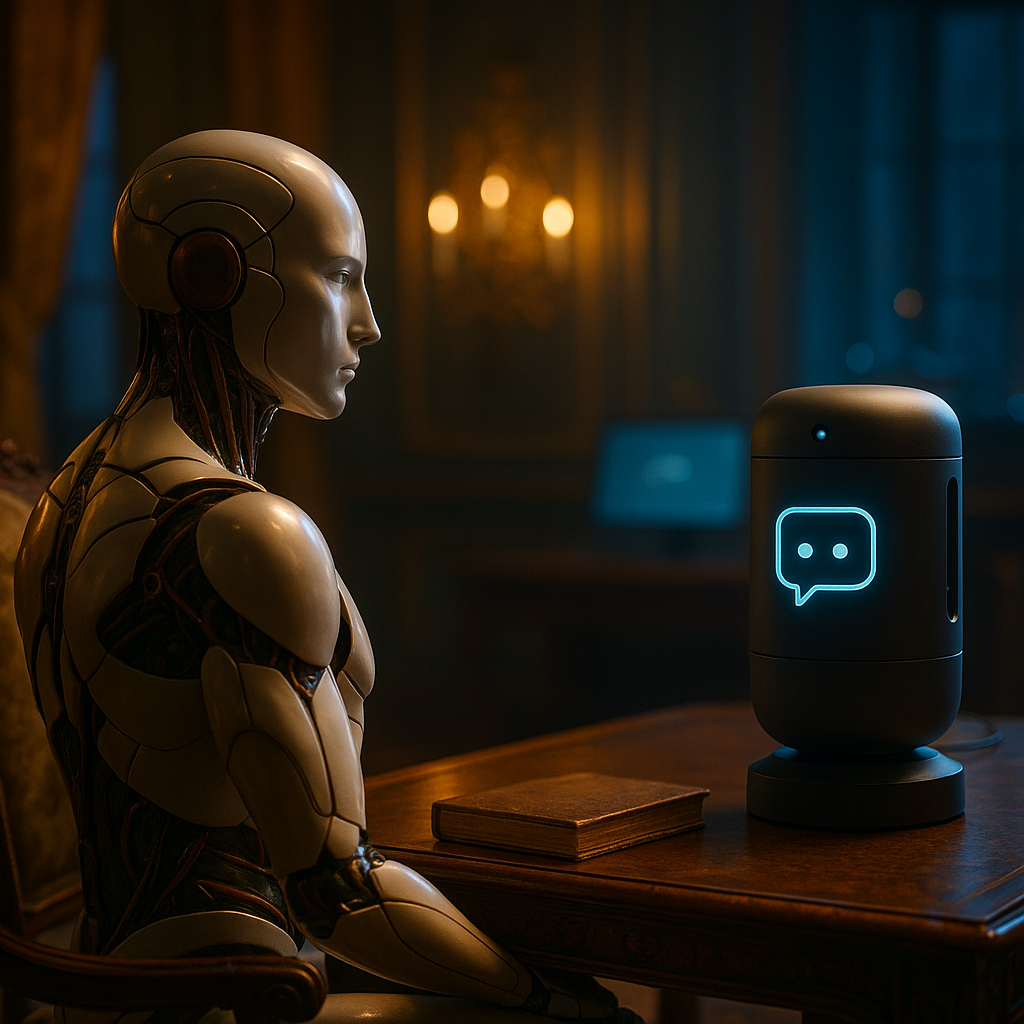
Here is the short answer leaders ask for: ai agent vs chatbot what is the difference comes down to autonomy, memory, and the ability to take real action. A traditional chatbot answers questions in a conversational way inside a fixed scope. An AI agent can understand goals, plan multi step tasks, use tools and company systems, and complete work on your behalf with oversight. For business, that distinction translates into whether you deploy a helpful digital concierge or an intelligent digital worker.
AI agent vs chatbot what is the difference in plain terms
Think of a chatbot as a guided conversational interface. It is great at handling common questions, simple lookups, and basic workflows through scripts and large language models. It can be smart at conversation but it mostly stays within a predefined flow. By contrast, an AI agent is an orchestrated system that combines reasoning, memory, tool access, and guardrails to pursue goals. It can break a task into steps, call APIs, update records, and confirm completion.
If someone on your team asks a chatbot for an invoice status, it will try to answer based on knowledge it was given. If the data is not in its context, it will not complete the job. An AI agent will authenticate, query your finance system, reconcile line items, send a customer update, and log the interaction, all under defined policies. This operational difference is the heart of ai agent vs chatbot what is the difference.
What a modern chatbot does well
- Answers frequently asked questions with accuracy and brand tone
- Guides users through simple steps like password reset or appointment booking
- Collects structured information to pass to a human or a downstream system
- Operates in channels such as web chat, messaging apps, and help centers
What an AI agent adds
- Understands goals, not just questions, and can propose next best actions
- Plans multi step workflows, checks its own work, and adapts based on outcomes
- Uses tools such as your CRM, ERP, or scheduling system with permissions
- Maintains working memory and longer context across sessions where allowed
- Escalates to humans with full audit trails and summarized context
At AI integration services we combine language models, retrieval over your knowledge base, and safe tool use to transform chat experiences into reliable business automation. This approach makes the discussion of ai agent vs chatbot what is the difference very practical instead of academic.
AI agent vs chatbot what is the difference in capabilities
Both chatbots and agents can use large language models, but capability design is distinct. This is where ai agent vs chatbot what is the difference affects operating models, not just user experience.
Autonomy and tool orchestration
- Chatbot: Responds in natural language based on prompts and knowledge. It may trigger a single simple action such as creating a support ticket.
- Agent: Chooses from a toolbox of actions, plans a sequence, validates results, and updates systems. It may run a full returns process that spans verification, label generation, inventory update, and refund initiation.
Reasoning, planning, and feedback
- Chatbot: Pattern matches and generates answers. Limited planning beyond straightforward flows.
- Agent: Performs chain of thought reasoning internally, decomposes tasks, and uses feedback loops to correct itself. This is the key engine behind higher completion rates on complex work.
Knowledge and memory
- Chatbot: Relies on a static knowledge base or preloaded FAQs. Context is usually per session.
- Agent: Retrieves and grounds responses in current data, can maintain user or case memory within policy, and writes back outcomes for future steps.
Security, governance, and guardrails
- Chatbot: Sandboxed with limited system access. Lower operational risk but also lower leverage.
- Agent: Uses role based access, audit logs, approval steps, and policy checks. An enterprise agent should align with frameworks such as the NIST AI Risk Management Framework to balance capability with control.
In short, ai agent vs chatbot what is the difference is the gap between answering and accomplishing. If a process needs decisions, cross system actions, and verification, you are in agent territory.
AI agent vs chatbot what is the difference for business outcomes
Executives ask where value shows up. Here is how the difference plays out in common functions and how to select the right fit. This section makes ai agent vs chatbot what is the difference concrete in terms of service levels, cycle time, and cost to serve.
Customer support and service
- Chatbot impact: Deflect repetitive contacts, provide instant answers, reduce handle time through triage and data collection.
- Agent impact: Resolve end to end cases like warranty validation, part replacement, and scheduling a field visit. The agent can check entitlements, order parts, and send confirmations.
Sales and marketing
- Chatbot impact: Qualify leads with a short conversation, answer product questions, and book meetings with calendar availability.
- Agent impact: Run a prospecting sprint by pulling target accounts, personalizing outreach, logging activity in CRM, and preparing a brief for the account owner. It can also generate quotes by calling pricing tools and approving discounts within policy.
Operations and finance
- Chatbot impact: Provide policy answers to internal teams, check status of POs, and point to how to guides.
- Agent impact: Reconcile invoices against contracts, update ERP records, flag anomalies, and request approvals if mismatches exceed thresholds.
When we help Toronto based firms adopt this stack, we start with a diagnostic that maps tasks by complexity, risk, and value. Then we determine whether a chatbot, an agent, or a blend will produce the best return. You can book a free consultation to walk through your stack and candidate workflows with our team.
From prototype to production with the right architecture
Moving from idea to production means designing for capability and safety at the same time. A robust agent architecture typically includes:
- Language model selection tuned to your domain and latency needs
- Retrieval augmented generation that searches approved knowledge sources in real time
- Tool connectors to CRMs, ERPs, data warehouses, and ticketing platforms with fine grained permissions
- Policy and governance layers for approvals, PII handling, and audit trails
- Observability to track flows, failures, and outcomes for continuous improvement
By comparison, a production chatbot often needs a conversational layer, intent recognition, knowledge retrieval, and escalation paths. That is why ai agent vs chatbot what is the difference also shows up in engineering scope and change management.
Our team at Prototype Toronto applies an agile discovery approach, builds a lean pilot, and expands capabilities in measured increments. We can start with a chatbot for rapid deflection gains and evolve into agents for the highest value processes as confidence grows.
Quantifying ROI and risk
Leaders need hard numbers. Here are practical metrics that reveal the real gap behind ai agent vs chatbot what is the difference.
- Time to resolution: Chatbots compress response times for simple needs. Agents compress completion time for multi step processes by eliminating hand offs.
- First contact resolution: Expect higher gains with agents on complex cases since they can act, not just answer.
- Cost to serve: Chatbots reduce contact volume; agents reduce back office workload by automating fulfilment steps.
- Revenue lift: Agents can execute proactive tasks such as renewals outreach and cross sell follow ups with measurable pipeline impact.
- Quality and compliance: Track policy adherence and audit logs, aligning with widely referenced standards like the Stanford AI Index insights to benchmark maturity and risks.
Implementation playbook for non tech companies
If your firm does not have a large engineering team, you can still move quickly and safely. A proven approach is to define the business outcomes first, then select the minimal viable capability that achieves them. For a support organization, begin with a retrieval powered chatbot to deflect tier one volume. For a returns workflow, jump straight to an agent with guardrails since users care about Done not Answered. This practical view reframes ai agent vs chatbot what is the difference as a sequencing decision, not a binary choice.
- Start with a discovery workshop to map processes, risk, and value
- Pilot a narrow scope with clear acceptance criteria
- Instrument everything for observability from day one
- Deploy human in the loop review where needed for approvals
- Scale with templates and reusable connectors
This is the type of engagement we deliver through our AI integration services, bringing a dedicated partner to co own your roadmap and results.
Common pitfalls and how to avoid them
- Over relying on a chatbot for tasks that require system actions. Result is frustration and leakage to costly channels.
- Under securing agents. Always enforce least privilege access, approvals for sensitive actions, and auditable logs.
- Skipping change management. Communicate clearly to staff how agents complement work, capture feedback, and adjust roles and workflows.
- Not measuring impact. Define baseline metrics and compare pre and post deployment outcomes to validate ROI.
AI agent vs chatbot what is the difference for your roadmap
Use this decision guide to choose where to start:
- If your goal is immediate deflection and consistent answers, choose a chatbot first.
- If your goal is cycle time reduction and outcome completion, prioritize an agent with measured guardrails.
- If you need both, start with a chatbot in customer facing channels, then add agents behind the scenes to complete tasks the chatbot initiates.
This blend aligns with the reality that customers want fast answers and fast resolutions. The smarter the sequencing, the faster your teams and customers feel the benefit. That is the practical essence of ai agent vs chatbot what is the difference when it becomes a roadmap decision.
Industry examples from the field
Retail and ecommerce
A retailer can launch a shopping assistant chatbot that finds products and answers policy questions. The returns agent works behind the scenes to validate orders, issue labels, and update stock. The customer experiences a single conversation but the orchestration under the hood spans both chatbot and agent.
Manufacturing and field service
A service desk chatbot gathers issue details and suggests safety steps. An operations agent dispatches a technician, verifies parts availability, and books a slot in the field calendar, then updates the customer with a confirmed time. End to end resolution time falls as the agent removes hand offs.
Financial services
A banking chatbot explains mortgage options and collects documents. A lending agent runs eligibility checks, calls underwriting models, and schedules a follow up with a loan officer, improving both experience and conversion.
Why partner with a local team
Success requires more than models. It needs process insight, integration engineering, and governance. Based in Toronto, our team understands the compliance context and system landscape common to North American firms. We help you select where a chatbot shines and where an agent delivers a step change in outcomes. If you want an experienced partner to scope, prototype, and scale with you, we are ready to help.
Conclusion: turning conversations into completed work
The takeaway is clear. A chatbot converses. An agent completes. In business terms, ai agent vs chatbot what is the difference is the leap from answers to outcomes. Use chatbots to deliver instant clarity and reduce contact volume. Use agents to execute multi step tasks across systems with policy and audit. Start small, instrument thoroughly, and expand based on proven ROI. If you want a pragmatic plan shaped around your stack and goals, our Toronto team is ready to collaborate.
Talk to our team about your workflows and goals. Get a roadmap that makes ai agent vs chatbot what is the difference work for your business. Contact us today.